
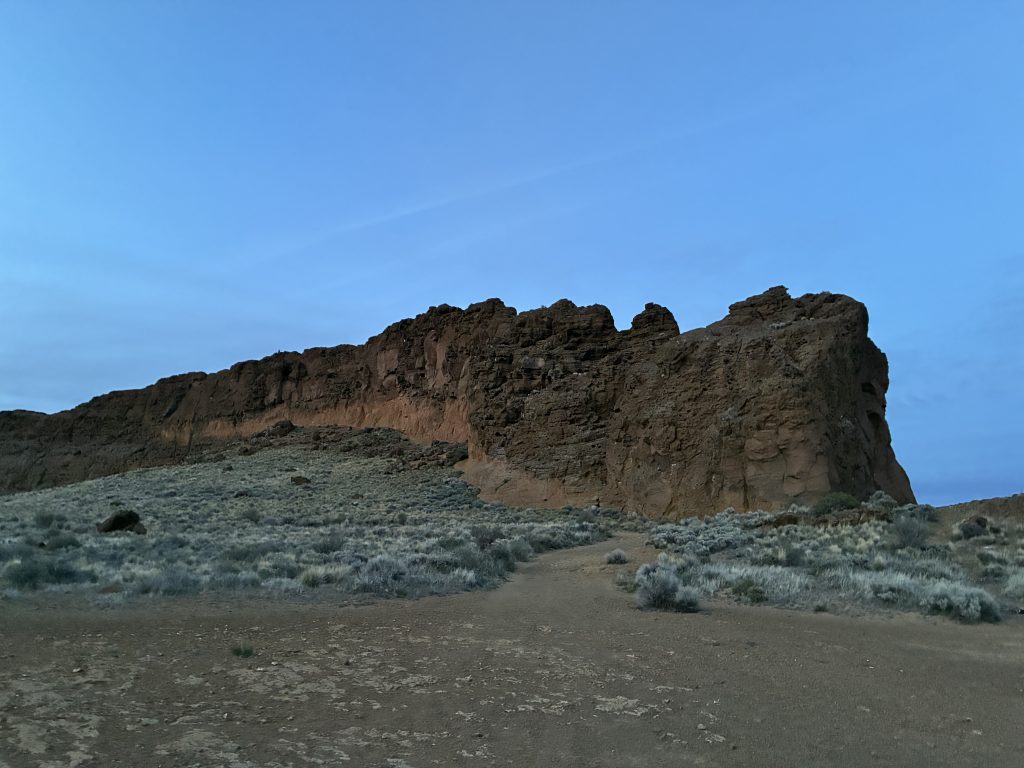
Many bucket-listing Canadians trumpet the famous West Coast sojourn of Vancouver to L.A. We all know about California, dude, and, being your first dip into America, Washington inevitably draws long-winded comparisons to B.C. Yet, so often, these distance drivers speak little of their trip down Oregon’s coast, never mind any description of its pristine roads east into the mountains. I suspect it’s because they don’t want to share what they found. Forget that. We don’t gatekeep here.
Get a car, bicycle, or e-bike and consider sampling any of these three magnificent routes from a six-day trip I took in April 2026. With out-and-out excitement constantly beneath your tires and way-out-there eccentrics beyond your passenger door, Oregon won’t be handcuffed with labels like “overlooked,” “best kept secret,” or “selfie-alert” for long.
Oregon Drive 1: Climate Changes

It’s a sign of the times that ordering an economy rental qualifies you to drive away in a midsize SUV or pickup truck at no extra charge. I had to repeat several times to the car jockey in the Portland, Ore., airport that I didn’t want any of the big vehicles they had, didn’t care that it was a free upgrade, and just wanted the Mitsubishi Mirage that I reserved weeks before.
It boasts a meaty 1.2L three-cylinder beast beneath the hood. Good for gas and hilarious on hills. I wouldn’t change a thing but clearly others had. You’ve seen the news; things have quickly evolved in the world. Back when gas was cheap a few months ago, some drivers would call the Mirage anemic. Today, they’d call it dainty or eco-conscious. I call it an entertaining choice for the extreme variety in the extremely fun-to-drive state of Oregon for two reasons.
Reason one: That variety I mentioned. There’s temperate rainforest along the coast beneath snow-capped mountain ranges, mostly angular volcanoes — some of which may blow any minute, making the roads that much more exciting to drive — and high desert, blocked from the rain by those intervening volcano ranges. You can experience all this in less than the distance between Toronto and Montreal, perennial contenders for first prize in the World’s Least Interesting Dangerous Drive.
Mind, that’s just the distance for variety. I put 1,692 clicks on the Mirage in five days, plus one three-kilometre toot to the Medford airport way too early on the trip’s sixth day. Let yourself wander in Oregon.

Reason two: There’s so little traffic. At least there was for the week I drove there in late April. Within an hour of landing in Portland on the first day, I was already thanking the Fates for the mostly solo performance. Following 16 hours into a long day of travel, that first drive was occasionally terrifying, if usually lovely. Why?
Day one’s route to the seaside town of Manzanita from the airport climbs nearly 1,600 feet over a coastal mountain pass before reaching sea level. On April 15, 2026, my subcompact climbed not just through changeable weather, but all-out climate.
In just over two hours, the Mirage saw it all: heavy rain like something from a Marvel movie’s funeral scene; moody grey mist; sudden stinging-bright sunshine like an orange juice commercial; hail — I didn’t stop to measure whether it was the de rigeur ball-bearing or the golf-ball-sized type they always quote in the news; and [expletive-deleted] snow.

Even snow? The week before I arrived, the temperatures here were in the 70s Fahrenheit. Should I have brought my parka, which, after the Canadian winter we had, smells like cheese? Fortunately, no. The subsequent days were all lovely.
The above list of weather conditions kept repeating in different combinations like a slot machine gradually draining your confidence. And yes, it provided plenty of challenge for the Mirage’s summer tires.
I rolled past an ugly truck-destroys-car wreck being attended by fire and police. Soon, several more emergency vehicles raced towards the scene in the opposite direction. But that was the day’s traffic and the only time I felt nervous throughout all six days and 1,695 km.
Oregon Drive 2: Wet Coast, Through Wine Country to the High Desert

As the majestic Oregon Osprey flies, Cape Meares National Wildlife Refuge and Park is only a few miles from my first two nights’ stops, Manzanita and Pacific City. However, earthbound tech like your car weaves, climbs, and switches back and forth and up and down for what feels like a couple of hours to get there. Regardless, the route is achingly pretty and never dull.
Indeed, this State Park may as well guarantee the Like buttons on your feeds get eroded sooner than its own cliffs. Bring a lunch and sit for a contemplative hour while those three cylinders in your economy rental catch their breath.
Then say goodbye to the Pacific for four more hours of driving. Within 10 minutes, we no longer passed signs reading “Tsunami Hazard Zone,” whose graphic waves seemed to be ridden by a surfer (actually an escaping sprinter — sardonic, yes, but even funnier) and “Evacuation Route,” which sounds like a rejected advertising slogan for Travel Oregon.

Now, the wide-open Pacific sky disappeared between narrow canyon walls overdressed in lush century-tall evergreens. Beautiful!
Here on the bereft upward-snaking road, you’re tempted to become cocky behind the wheel. If you’re lucky, an 18-wheel lumber truck may trundle around the coming corner, alerting you to the real versus perceived risks. Rather than photographing through the windscreen, I pull over a few times to park and capture the bendy, rolly roads before resuming.

Before long, the vista widens again, revealing some of Oregon’s wine country. The view is as mellow as an Oregon Pinot Noir (expensive but life-affirming). Then you’re back in the wobbly bits to cross a mountain pass and presto: arid, quasi moonscape.
In half a day, your drive has gone from CBC’s Beachcombers B-roll (look it up, kids) to the final shot of Terminator 1. There are still hardy evergreens up here, but soon you’re driving through a Roadrunner cartoon.

How did they squeeze a desert so close to the ocean? Geographers and meteorologists (interestingly, people who study meteors aren’t called weather prognosticators) will quibble with my oversimplification, but ostensibly the mountains block the rain.
It’s been over four hours of driving. Time to rest and explore the curious human activity. If you can think of a better name for a community full of eccentrics than Bend, you win a prize. About 300 km from Pacific City and 1,100 m up, it sits in the heart of the High Desert. Speaking of regional names, three guesses why it’s called High Desert.
Oregon Drive 3: Continue Up Snowbound Volcano Roads

Just five paragraphs ago, you were admiring seaside lusciousness. Now, you’re 2,400 m above sea level in Rim Village, the tourism centre abutting the cratered lake in Crater Lake National Park. Snow abounds up here well into spring, and you’d half expect the frozen torso of Jack Nicholson to jut from the plowed heaps outside the gift shop.
Oregon suffers an embarrassment of geographic riches, but Crater Lake takes the cake. It’s a stratovolcano that blew its top so profoundly 7,700 years ago that it caved in on itself. Judgy geologists would probably demand a uranium sample, but ostensibly, the heat from the blast baked the inside of the volcano into a huge, almost watertight bowl. At 594 m, it’s the deepest lake in the USA. The allegedly “Great” Lake Erie is just 64 m.
The 53-km Rim Drive, a circuit road around the perimeter above the bowl, doesn’t open till late June, sometimes early July, then closes again in October or November. So why visit now? Same reasons as first espoused: the variety of superb, pothole-free roads and a lack of other drivers creating potholes. Weighing just 960 kg, a lone Mirage would take 7,700 years to create potholes you’d find in most Canadian cities.

Epilogue: Oregon Drive 4?
The sixth day of my visit technically included a final drive, just a three-kilometre jaunt to the Medford Regional Airport on flat, empty suburban tarmac. But with a flight lifting off at 6 a.m., I was nearly hallucinating with exhaustion when dropping off the rental at 4 a.m., arguably making this the most challenging drive of all. The biggest challenge? Trading the relative spaciousness of the Mirage for a knees-in-my-face constricting seat in the back of an Embraer 175 that was taking me back home.
Photos by Steven Bochenek