

The following was published in the Winnipeg Free Press in September 2021, during a pandemic. Take it away, past Steve ...
Have you ever driven right across Canada? Me neither. But I did just help move my daughter, Justine, from Victoria to Toronto in a tightly packed Pacifica Hybrid minivan supplied by Chrysler. Victoria to Toronto is a trip many people would call crossing Canada — especially the Torontonians — but there are those other 2,000 kilometres just to get to Halifax, never mind St. John’s.
Still our almost 5,000 kilometre drive covered five huge provinces and the experience taught me a few important lessons. Forgive any blinding flashes of the obvious in the headlines; there’s meant to be deeper wisdom just underneath.
To quote happier-than-ever teen idol, Billie Eilish (not to be confused with ancient idol, Billie Idol) from one of her biggest hits: “Duh!”
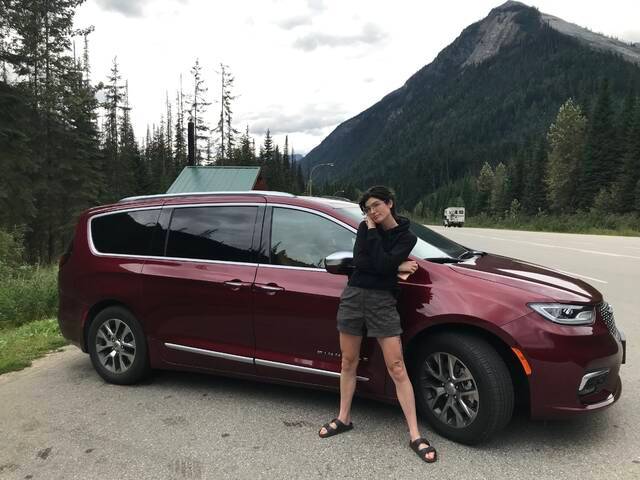
But Billie would be right. Canada’s not just big, it’s really big. It’s vast, immense, Brobdingnagian, exhaustingly big.
So, give yourself plenty of time. I was away nearly two weeks and drove for nine days. My daughter, though much older than Billie Eilish, doesn’t turn 25 for two more weeks, so I did all the driving. We took our time but, even then, experienced only a couple of short driving days.
Day 1, pick up the Chrysler Pacifica Pinnacle Hybrid in Vancouver.
Day 2, drive, ferry, and drive to Victoria – 120km; move unneeded furniture from my daughter’s apartment to forever homes
Day 3, pack the Pacifica with what’s left
Day 4, drive, ferry, and drive from Victoria to Osoyoos, B.C. – 500 km
Day 5, Osoyoos to Canmore, Alta. – 600 km
Day 6, Canmore to Drumheller, Alta. – 230 km
Day 7, Drumheller to Cypress Hills Interprovincial Park, Sask. – 380 km
Day 8, Cypress Hills to Saskatoon, Sask. – 440 km
Day 9, Saskatoon to Riding Mountain National Park, Man. – 560 km
Day 10, Riding Mountain to Winnipeg, Man. – 270 km
Day 11, Winnipeg to Atikokan, Ont.– 580 km
Day 12, Atikokan to Sault Ste Marie, Ont. (aka The Soo) – 890 km
Day 13, The Soo to Toronto – 700km
You may notice, above, how we rocketed through the mountains and meandered through the prairies. Normally we’d also take our time in the mountains of British Columbia and Alberta, but this summer wasn’t normal and we worried about wildfires causing highway closures — or worse.
We could’ve powered through and been home in five days. However, by adding nearly a thousand kilometres more than we needed, we saw many gobsmackingly beautiful corners of Canada, and enjoyed laughs with lovelier Canadians in Canmore, Alta., Saskatoon, Sask., Winnipeg, Man., and Sault Ste Marie, Ont.
Deer in Victoria, grizzlies in the mountains of B.C., gophers on the prairies, black bears in Ontario, and coyotes everywhere — Canada’s cities, exurbs and countryside are rife with animals that get spoiled by (albeit well-meaning) humans. Please cease.

On our first day of driving, my daughter got to say goodbye to a friend who’d left Victoria far earlier in the summer. Gemma happened to be available when we drove into the family camping resort where she worked in the dramatic Cascade Mountains.
The job: teaching city people vital lessons like, “Please don’t feed any wildlife. We don’t want to have to shoot a mother bear later because you taught her to view humans as unlocked vending machines.” Sure, the lesson traumatizes visiting children and chastises guilty adults, but that’s just a couple of the benefits of her job in this picturesque paradise.
For much of western Canada, you enjoy four-lane freedom on the Trans-Canada. Driving the route was pretty much hassle-free from Victoria all the way past Winnipeg.
Then in parts of northern Ontario, the Trans-Canada’s suddenly a little more than a dirt road. At such times, it also substitutes as a parking lot; you can spend up to an extra hour a day waiting to pass through construction zones that reduce this alleged highway to a single dismal lane. And this is written by a Torontonian, someone who’s used to horrible roads, clogged with bad drivers.
In many places, geography and climate affect how locals see the world. We’re all Canadians but regionally, we differ significantly. That said, the following examples are just my experience and may not reflect yours.
In Victoria, I befriended a 31-year-old bicycle racer who’s travelled much of the world for his races but still hasn’t earned his driver’s license. Then again, it’s almost never winter in Victoria, the quality and quantity of cycling infrastructure are Scandinavian, and cars are expensive.
In western Alberta, a contractor who advertises his services on the side of his Ford pickup truck clearly resented being passed by a minivan and dangerously tailgated until overtaking us on a narrow mountain passing land. I didn’t pass another contractor the rest of the trip.
I met a 27-year old prairie farmer from the Cypress Hills in Saskatchewan who’d inherited his uncle’s ranch “up the road a bit” and offered to take us there. It was 100 kilometres away.
Every Manitoban, Saskatchewanian, Albertan and British Columbian I’ve ever met is proud to be from their province. For all the Ontarians I know, their province is simply an office that issues health cards and regulates the strangling-slow speed limits and overpriced liquor stores. They’re proud to be from the hometown and Canada, but pride for their province makes as much sense as being proud to be from North America.
Stealth police SUVs have their emergency lights carefully cached within the ceiling. What looks like a plain black vehicle may not be.
If you’re exceeding the speed limit on an otherwise empty stretch of highway near, say Wawa, Ont., and a black Ford appears in the distance, then speeds up to just behind you — well, it’s probably too late. I got a speeding ticket but, thank heaven, it didn’t include any insurance demerit points.
The real lesson here in #6? Re-read lesson #1 and take it to heart. For all its problems, Canada’s still a beautiful country full of wonderful people. Slow down and enjoy.