

The first section of the following was published in Vicarious Magazine's Fall 2025 edition, while the second was on its website. But you can read them both here — together at last. Take it away, past Steve ...
From Tragic Beginnings to Hollywood Endings: The Extremes of The Baja 1000
Prologue — Friday, November 15, Mile 160 on Race Day: “Good thing I’m circumcised.” The fine desert sand, nailed home by Pacific wind, gets everywhere. 100 feet back from the crest of a steep sandy bluff, Larry’s Silverado truck bed makes primed viewing for the race.
Like the cartoon wakes of approaching Tasmanian Devils, dusty overhead blooms expose Trophy Trucks otherwise racing unseen through a distant gully. Thousand horsepower engines bellow like a ‘70s Who concert.
“You don’t want to be too close when the trucks come over the hill” understates Larry. No need to explain why.
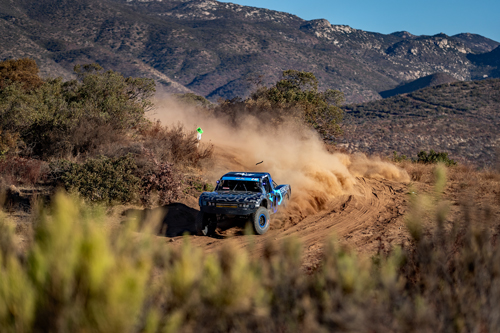
With a sonic boom, his racer pal Brad Lovell suddenly pilots a Ford Bronco DR that would fail even a Russian Olympics steroids test two feet in the air over the lip of the crumbling bluff before landing clumsily — WHUFFFF — like 3,500-pound bouncy castle on 35-inch tires. Yes, it looks goofy. That is until you see this metal circus elephant struggling against inertia to keep from sandplaning at speed into overly ambitious viewers — like us.
Welcome to the Baja 1000 desert race experience. Many fans call it the hardest race in the world. But it’s really 37 races with its many vehicle subclasses. Or even 282 races, given all these registered entrants ultimately competing against their own mad selves.

From here, the racers’ upcoming challenges include over 700 more miles battling sand and crumbling verticals … sudden foot-wide crevasses in rock … blinding clouds of dust … or worse, rain showers that conspire with the driver in front to splash tsunamis of silt over a racer’s visor, rendering blackout curtains in the blink of an eye … plus hours of desert squinty night-driving, amplifying hyper-anxiety, woolly exhaustion and a constant need to pee.
Larry’s advice to stay back is valid. Yesterday before the race even started, two people were killed. "WHAT?!" Yes, fans crushed by an incompetent competitor near the ceremonial starting line. The driver’s in police custody. SCORE International Off-Road Racing, presenters of this and Baja’s three other races, decided their show must go on.
 2 fans were crushed to death when a 'driver' hit the wrong pedal in the contingency inspection lane.
So: Dehydration, danger and, yes even death. Why would anyone choose to love this annual challenge of human extremes? Why do they love it? Let’s back up a couple of days and explore some highlights of this trip, courtesy of tire manufacturers BF Goodrich (BFG). The brand’s been deeply involved in Baja racing since before you were born, so following their schedule should mean we’re not missing anything important.
On BFG’s behalf, our transport and regular colour commentary is supplied by Larry McRae, winner of multiple Baja (and other) races. Originally there were to be two other auto writers following BFG’s carefully planned schedule, but they aren’t here. So, you and I get Larry plus BFG PR rep Andrew all to ourselves throughout the week. This must be how Kardashians feel.
Warning: If you’re looking for nerd status, listing who won what, visit SCORE’s website. If you’d like an up-close peek behind those silted curtains into this immense racing subculture, buckle up your five-point harness. The following jumps around in time but remains extreme. Speaking of jumping around …
Thursday, November 14: one sleep before race day.
8:30am: “Those extra breakfast burritos were a mistake.” You may have to re-swallow them, once we’re rollercoasting shotgun in a Polaris RZR beside second-generation desert racing royalty with the unspeakably hard-to-spell name, Cayden MacCachren, scion of G.O.A.T. Rob MacCachren. Not everyone is sure he’ll continue his reign much longer.
 This is Cayden. Imagine Luke Skywalker channeling Pig-Pen.
21 and already a champion, Cayden didn’t start racing till he was 16. (Apple, meet tree.) He’s been doing pre-run trips around this 864-mile odyssey all week, constantly making and revising plans. We’re about to do a 20-minute sample of his impending 20-hour race. Hope you packed your travel health insurance.
First, we struggle to don the racing harness. Picture the offspring of a seatbelt and straitjacket. After a humbling few minutes, I can hear Cayden say, ‘Can you hear me?’ in my connected helmet like some youthful Obi-Wan Kenobi recommending The Force. “Yes” we hear each other, Ben!
So, with a leonine ROAR we’re off through the starting gate! Talk about an authentic experience, this is where the race will leave from tomorrow, safer than downtown Ensenada.
Speaking of authenticity, the terrain here instantly varies so much — climbs, drops, corners, dust, wide crevasses, rocks, bumps and scrub — it feels more like a 3D video game. But it’s not. And I’m (understandably) nervous we’ll tilt into full game-over.
Unfazed, Cayden reads the terrain well enough to render his bounding side-by-side part hovercraft. Meaning? Between his honed intuition, BFG tires the size of a mariachi band, and shock absorbers that could catch a falling asteroid, some of the ride feels like you’re floating. The rest? It’s like you’re the asteroid, skipping along the atmosphere edge: violent bounces, intense heat — and sudden surprises. Like this other pre-runner suddenly cutting 30 feet ahead then dipping into a shaded gulley.
Poof! We’re engulfed in dusty cloud, a la Pigpen. It won’t settle for minutes because we’re sheltered from winds in this channel. Sun rays filter through but I don’t see any path.
Untroubled, Cayden shoots us out, then — whooff — into a dozen deep soft moguls composed of sand, not snow. “Oh. That’s not good for this vehicle,” Cayden observes flatly, but too late to avoid the first thick bumps. Counterintuitively, he accelerates to ride atop these axel-choking two-foot soft drops before veering up to a flatter, more solid path.
Up ahead, two locals are switching direction signs. They’re probably farmers who decided that this year they don’t want their cow pasture shredded for days on end at 200 decibels. (Making this mostly off-road race possible requires much good faith of countless locals.)
The race “route changes, last minute, all the time,” Cayden Wan Kenobi’s voice reports. Consider all the practice and planning a winning team does. You drive the route multiple times, scanning, making notes, strategizing. Then farmers change it like that, turning your plans to … sand. “Some people get frustrated with it. I don’t because there’s nothing I can do.” At 21 that’s some experienced wisdom.Another vehicle from this newly adjusted route cuts in front, blinding us again though it doesn’t slow Cayden. Does he have x-ray vision or something extra? Right now, I’d be happy with a catheter.
 Cayden's father, Rob MacCachren, the G.O.A.T. with the author in mid-expression.
Then, zing, we’re up a hard rock ridge and suddenly can see again. To be honest, this is wicked fun and I’m looking forward to driving a buggy on a similar route this afternoon.
First, though, we must drive back to town, a short distance but thoroughly clogged slog …
11:30am: The traffic back to the ceremonial start/finish line was almost as thick as Toronto’s must be this Taylor Swift and Grey Cup weekend. We’ve barely made it back to the Riviera Center in Ensenada in time for the pre-launch SCORE media conference.
Odd. During this ‘news event’ there’s zero mention of that utterly preventable tragedy from just 50 minutes ago and 200 meters away. Indeed, we won’t learn of it for three more hours this afternoon but, in the Contingency inspection lane approaching the ceremonial start, four spectators were just crushed, two of them — both Americans — to death. The vertigo from Cayden’s rollercoaster ride has nothing on this news.
... See Part 2
*Editor’s note: At this point, we welcome readers from the paper Vicarious magazine who arrived here via QR code, technology invented by Japanese auto parts manufacturers. Subscribe today and never miss an issue! It’s on sale now and also makes a great holiday gift.
3:30PM: Just 13.5 miles from this morning’s pre-runner ride at Rancho Nelson, Horsepower Ranch offers private desert racing experiences in custom built buggies. Paired with a BFG tire engineer, I get the driver’s seat because I drive stick. Huzzah!
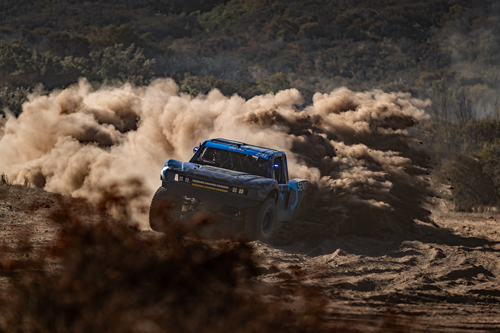
2024 Baja 1000 (photo credit- GETSOMEPHOTO)
To call the ride exhilarating does disservice. The ignition’s more like an eruption: a full body massage. Then, the heady mixture of danger, speed, hills, turns, dirt, noise, crevasses, climbing rocks — and dumping rolls — ensure a 30-minute braingasm.
Tie a knot in a piece of dental floss then crumple and hurl it into a dusty bush. That’s what our ‘lap’ looks like: all turns, drops and climbs. You learn fast to trust the shock absorbers and ignore any impulse to decelerate for upcoming bumps. Instead, rip into them as Cayden did this morning.
Each lap instills confidence, encouraging more throttle. Even the temporary blindness of Larry’s vehicle in front (of course) doesn’t bother or slow us. My racer’s confidence increases. We’re soaring, bouncing the snot out of the shocks and almost achieving touches of air.
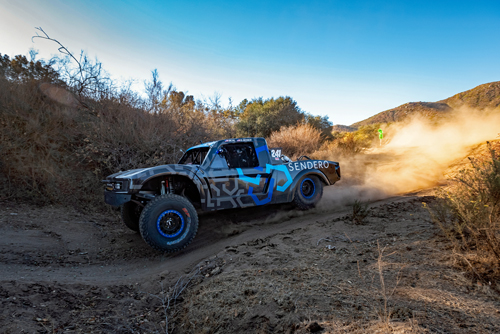
Until, whoops, that becomes overconfidence! We’re dustplaning sideways, then spinning 720 degrees before stalling backwards on a 30-degree hill. It’s probably safe but we can’t see anyone possibly ascending from behind. There’s no mirror and we’re strapped in like astronauts. Only our arms can move.
Re-igniting then slipping into first gear without sliding backwards into 20-foot cacti provides an embarrassing lesson in desert driving. Suddenly the helmet doesn’t feel as snug.
But then first gear holds — ROAR — and two final laps apply thick icing atop the best desert dessert ever.
Five minutes later, I unbuckle and exit the buggy, only seeming to touch the ground while still unconsciously stomping on a phantom clutch. How could this experience become even better? The Horsepower Ranch hosts hand us cold beer!
It’s at this point, several hours after 10:40am, that we learn of the morning’s mortal disaster in the Contingency Lane. Extremity travels in every direction.
Why was it called Contingency? Doesn’t the word mean ‘just in case’?
Wednesday: 2 sleeps before the race, it’s all pits and poses.
“What a freak show!” This is one day earlier, the trip’s first morning. Beyond freak show, how else to describe Contingency Day at the ceremonial start/finish line, Ensenada, Baja — especially jetlagged, early in the morning after a 20-hour day of 2024 travel?
Surreal sounds too boring. So, picture a fever dream mixing a Parisian Catwalk with chimera Mad Max vehicles.
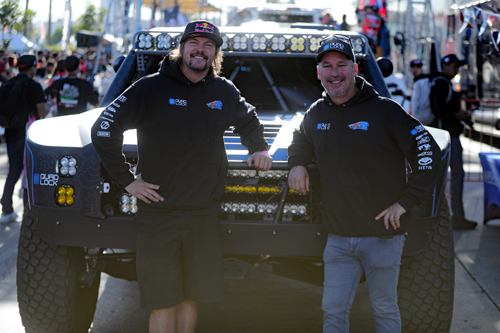
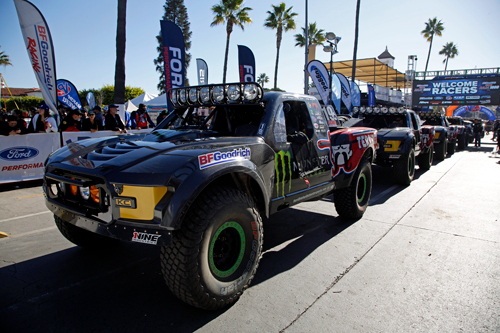
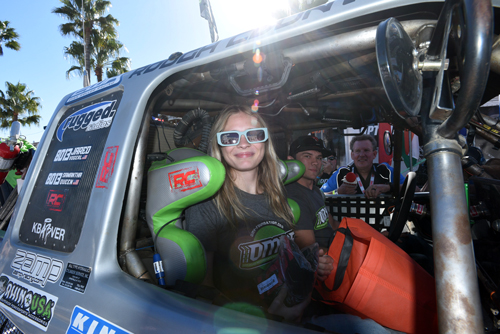
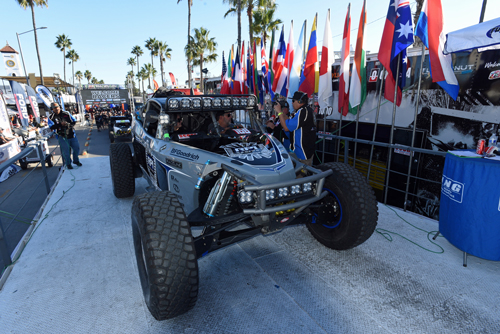
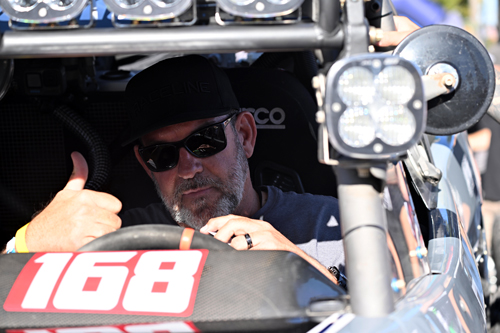
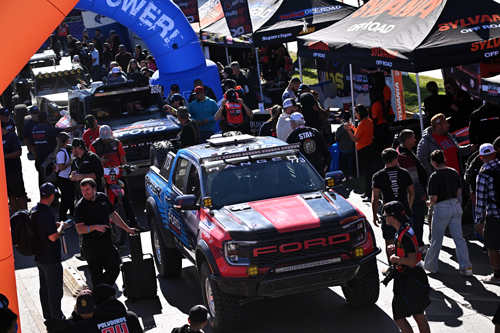
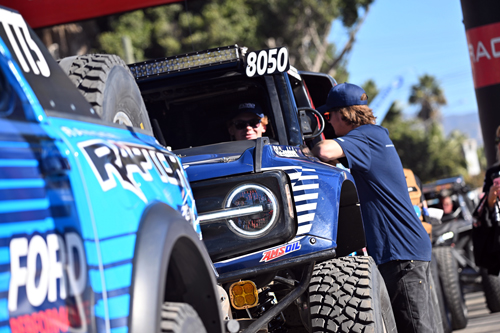
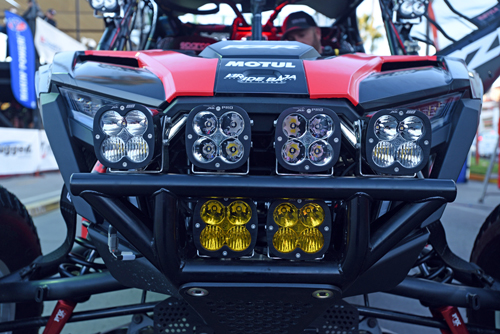
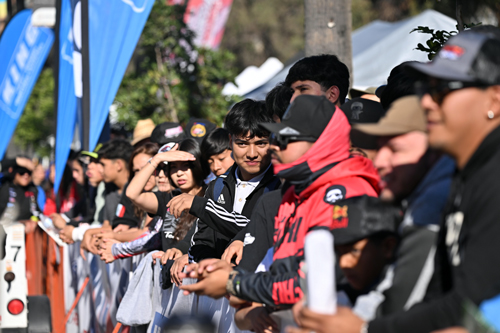
We’re in the ceremonial start/finish lane. (BFG wrist bands allow us access nearly everywhere.) For safety’s sake, the actual race begins and ends 23 miles from Ensenada at that decidedly unMexican-sounding Rancho Nelson. Contingency Day is for vehicle inspections, but this area becomes celebration central for fans and the nerve center for the organizers.
Beyond this parade lane’s rickety temporary fence, the scene is noisy and claustrophobic, packed with vendors, teams, stray dogs, volunteers, police and, of course, fans. The bon homie’s contagious like that almost-out-of-control parade dance Ferris Bueller leads on his day off. Imagine being in a pleasant mob. “This is nothing,” Larry says. “Tomorrow, there’ll be thousands!”
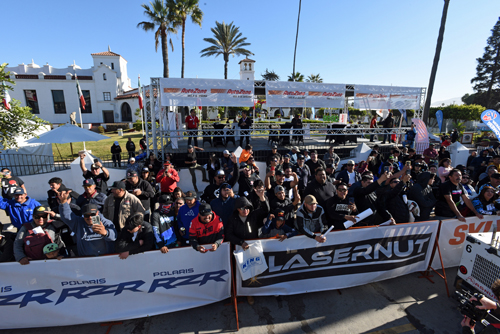
The fence keeps most fans from touching the noisy half-mile parade of roaring chrome gradually inching its way beneath inflatable triumphal arches to the ceremonial start/finish ramp. A broadcasting host, unable to discern Canadian accents from Australian, conducts pointless interviews increasing the chaotic noise.
Towards the middle of the parade, we’re nearly blinded by a hot pink UTV that Barbie might drive. It’s populated and surrounded by the team of Eva Star, a 17-year-old third-generation racer who began racing at 14. The pink passenger’s door features a small, sweet memoriam: “RIP+ Uncle Ruben and Grandma Esther”.
The procession presents other sweet stories. Consider last year’s Hollywood ending from Den Undah: Australian Wouter Van Dijk entered and won the Iron Man (aka soloist rider) motorcycle class, having purchased a bike nearby to enter the race last-minute. To qualify on Contingency Day, he had to replace the tires! Such race winners do receive cash prizes, but Baja’s far more passion project than get-rich-quick scheme. Larry understates again, “Unless you start racing early in your childhood or your daddy owns a casino, competing in these races is a great way to go broke.”
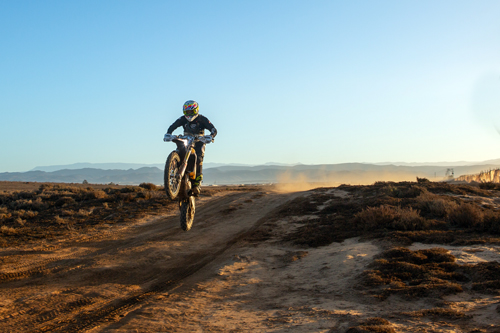
Many racers enter to test their own limits. Teams of Iraq and Afghanistan vets race in stages, learning to live with amputations and chronic PTSD. Today, they can’t walk two paces without being thanked for their service. Sometime late on Friday or even late Saturday, only 179 of the 282 entrants will even finish the race — just 63 per cent. Sounds like high school.
Let’s get out of this packed lane. There’s a private bar beside BFG’s shaded viewing platform for those of us with access passes. It’s hellish work but someone needs to document the heady smell of double margaritas amid the gasoline fumes, grilled street corn and sunscreen. Smells like victory lane.
The operations hub nearby is housed in a traditional-looking Spanish era mission. Turns out it was a casino, built long after the Spanish left. Today it mostly hosts weddings, parties, corporate offsites, and mega-events like today’s freak show.
As you know, in 24 hours, the chaotic carnival atmosphere will switch like a light to simple tragedy.
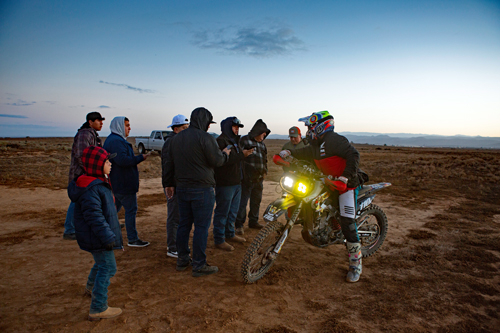
Friday, finally race day, BFG Pit #1: Larry says “the real heroes are the chase teams” whose names don’t appear in the press but who facilitate dreams and up-to 36 hours of punishing Baja reality. They haul whatever racers may need to pre-planned pit stops.
Racers need multiple pit stops and a team of experts who can solve the inevitable extremes. Wealthier teams strategically plan their own pits, estimating when and where they need to be ready. A few are even supported by helicopters following them, communicating upcoming conditions from on high.
For the rest, there’s affordable support from BFG.
Here at BFG Pit #1 at about Mile Marker 145, this for-profit tire company provides comprehensive pit services almost free to those racers without helicopters. Their six pit stops offer pretty much everything competitors need, from tires — duh — to food/fuel, even medics and welders. (The outhouse is primitive but locks from the inside.)
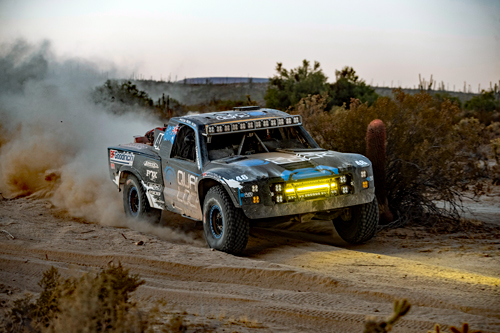
The support’s invaluable. Cole Connor, a mechanical wizard from Seneca, SC, temporarily resident here in Pit #1, proudly declares that anything steel, they can heal — “we put it back together” — lickety-split.
The medics matter. Early this morning before the Trophy Trucks even launched, a motorcyclist was being airlifted to hospital. “He knows his own name” motorsports organizer Nate Hunt learns by satellite phone from BFG Pit #3. Well, that’s a positive sign, right up there with breath, a pulse and no external bleeding.
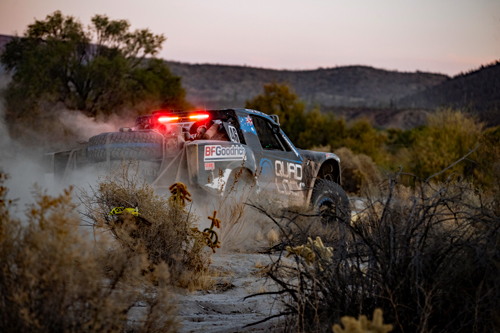
Satellite phone? The BFG team builds multiple layers of backup communications beyond the spotty desert cellular service, including even Google Earth and sometimes prayer.
And BFG offers all this service is almost free. “Usually, $1 per mile” Nate explains. “So full service for this race was $800.” Such service across six self-funded pit stops would cripple most teams.
“They also receive the mapbook and GPS files with all the access road information.” The level of logistical detail in that book would shame Amazon on Black Friday. These people, many of whom are volunteers, hand-picked from scores of would-be fan-nerds seeking up-close race access, must begin planning next year’s race before they even start packing up the motorhomes at these pit stops.
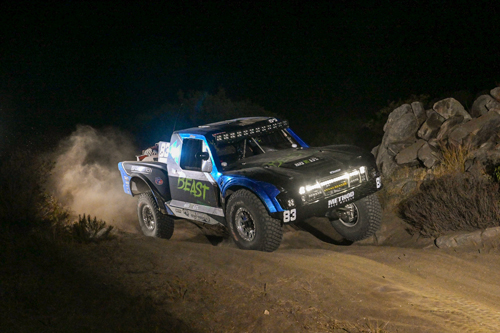
So, why does BFG offer all this? It’s not charity. This race doubles as their 800-mile tire laboratory, where they observe how the rubber meets the road, silt, sand, rock, air and occasional wandering cow. Their engineers attend to learn IRL how their lines of tires perform in these extreme conditions. Of particular interest are the KO3 and KM3 lines, key players in the brand’s Terrain Family.
While we’re onsite, Eva Star arrives, the hot pink now filthy tawny. Very much a 17-year-old, she hollers honestly “I need to wee!” See above re desert winds and Pit #1’s primitive facilities. Rehydration here proves a fine balance.
2:00AM Saturday, November 16 — the Hollywood ending: I awake to Andrew’s tapping at the hotel door. “The winners will be arriving in about 20 minutes!” We’ll meet downstairs in three to be onsite in time.
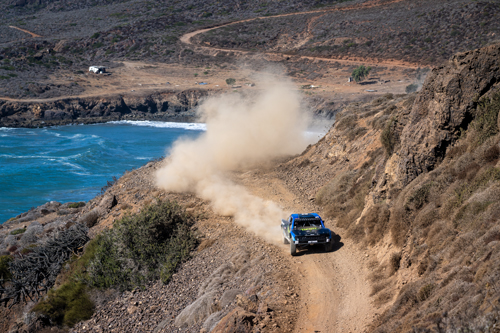
From this moment on, everything gets so cliché the reportage couldn’t make a first draft in a Disney movie.
Example? For the first time this week, the traffic in Ensenada isn’t slower than walking. We make the parking lot beside the finishing line and get a spot worthy of Kojak for Larry’s truck. The announcer’s broadcast sounds urgent. We have maybe three minutes before the winner arrives. What timing!
Then, uh oh! Rumbling clouds sweep over what was a clear sky ten minutes ago. The air’s pregnant with threatening rain. We start running to the entrance where our wrist bands worked all week. But we’re not allowed access here tonight. The guard signals towards the other end, 500m in the other direction. Oh now, we’re running out of time!
Fat pellets of rain start to land on our branded BFG swag which was designed to keep us warm but not dry. We run.
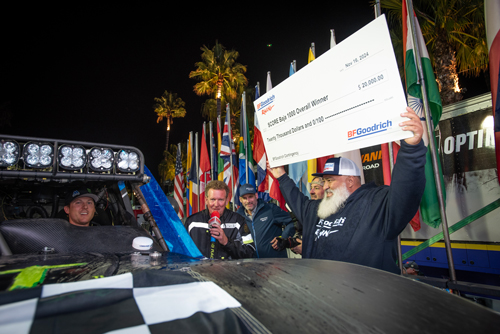
Before the rain truly lashes, we enter 100m behind the finish, zigzag between fans and guards, waving our almost all-access wrist bands, charging to the finish line like slo-mo lovers finally getting together at the end of the worst romcom you’ve ever been subjected to.
Next? More cliché. Exactly when we arrive beneath the BFG motorhome’s awning behind the finish line, the first winners arrive in front of it. How could you amp such cliché up further? The skies finally open, drenching everyone else not beneath the awning.
Not to be outdone by our almost scripted timing, a member of one motorcycle team proposes marriage on bended knee to his girlfriend on the stage. In the rain. On live video.
It happened. Could we make this yet more paint-by-numbers storytelling? Yep!
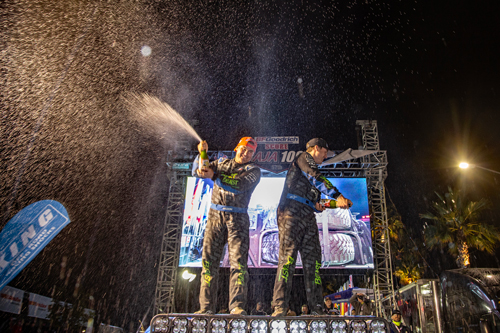
The overall winner is Rob MacCachren. Despite the extreme challenges of this season and race, the G.O.A.T.’s reign continues.
Now back to bed. We’re leaving in six hours, racing the departing traffic back across the border.
Epilogue — Saturday, Nov. 16. Picture an AI-generated vision of heaven and you could get Harbor Island, San Diego. Servicing the nearby airport, this flat and inoffensively perfect two-mile landfill features marinas and hotels with saturated green lawns. We have a few hours left before sundown. Our flights will leave an hour before dawn. The free bikes from the Hilton aren’t permitted off the island so, functionally, neither are we. We’re stranded in this paradise.
Earlier, even this morning after the first competitors crossed the finish line, the official border between Tijuana and San Diego was far from the hell the media purports. But it does have a demonic carnival atmosphere with jugglers, singers and desperate families on the Mexican side wandering through the lines, selling tat, soliciting donations for unrequested performances and simply begging.
After three days of extremes, celebrations and unrelenting stimulus, Harbor Island isn’t a metaphor for Heaven, it’s dull Purgatory.